These are all the cameras I’ve ever owned – starting with a Canon Rebel 35mm SLR in high school and ending with the latest Pixel. The film rolls live in shoeboxes, not in metadata, but every digital photo carries its camera’s name quietly in the EXIF header. I scanned the EXIF headers of 94,000 Google Photos and found 75 different cameras spanning 22 years. Some were mine. Some were friends’ phones showing up in shared albums. After filtering down to just the cameras I actually owned, the timeline tells a clear story.
One caveat: this is JPEG only. The pipeline skips raw files – CR2s from the Canons, NEFs from the Nikons – because Google Takeout bundles the JPEGs but not always the raws. So the real photo counts for the DSLR era are higher than what’s shown here. The raws live on hard drives, not in the cloud.
After scanning 723GB of Google Takeout data to build this site’s photography gallery, I had the pipeline and the raw material. So I pointed a Python script at all 15 zip files, read the first 64KB of every JPEG to extract the EXIF header, normalized the camera names, and loaded it all into a SQLite database.
The timeline
The pattern is clear: dedicated cameras dominated until around 2013, then phones took over completely. The transition wasn’t gradual – it was a cliff. Once the Samsung Galaxy Note II arrived, the Canon PowerShots and Nikon DSLRs collected dust.
The eras
The earliest camera in the data is the Sony Cyber-shot DSC-V1, which became the real workhorse of the compact era: 3,845 photos over seven years. Canon PowerShots, Pentax compacts, more Kodak EasyShares – a new camera every year or two, each one a modest upgrade. This was the age of carrying a dedicated device in a belt pouch and hoping the batteries held.
The DSLR era was really just one camera: the Nikon D3100. It was the real commitment – 5,729 photos over six years. It lived in the camera bag for every family trip and holiday. But carrying a body, two lenses, and a charger loses its appeal when the thing in your pocket takes a photo that’s good enough.
The phone revolution hit around 2012. The Samsung Galaxy Note II changed everything – 11,039 photos on a single device. Then the Note 4 pushed even further: 12,704 photos, making it the single most-used camera I’ve ever owned. The compact cameras and DSLRs were done.
The Pixel years run from 2016 to present. Google Pixel XL, 2 XL, 3 XL, 4 XL, 5, 6 Pro, 8 Pro, 9 Pro XL, 10 Pro XL. Nine Pixels in ten years. The best camera is the one you have with you, and the phone won that argument decisively.
Phone vs. dedicated camera
The crossover happened around 2013. By 2018, dedicated cameras were effectively zero. Computational photography didn’t just match optical quality – it made the camera you always have with you the best camera.
The cameras
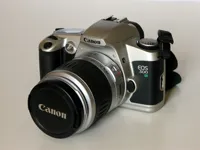
~1998 · 35mm film SLR · No EXIF data
The one that started it all. A run-of-the-mill Canon Rebel that I used in high school photography class. The rolls of Kodak Gold and Tri-X are in a shoebox somewhere, but this is where it began.
How I built this
Nearly a terabyte of Google Takeout data. Twenty-two years of photos. The pipeline is four Python scripts: scan_camera_exif.py rips through every JPEG across 15 zip files, reads the first 64KB to extract the EXIF header, and loads it into SQLite – three parallel workers, 30 minutes. normalize_cameras.py maps raw EXIF strings to clean names (Samsung’s EXIF says “SM-G920V” not “Galaxy S6”). export_camera_timeline.py and export_photo_stats.py query the database and output the JSON that powers these charts. The result: 94,000 photos with every camera, aperture, ISO, focal length, and GPS coordinate preserved in a queryable database. Charts are self-hosted Chart.js – no CDN, no npm, just a single JS file.
For the deep dive into what all that EXIF data reveals about shooting patterns, see 94,000 Photos by the Numbers.